The Dust and the Silence
Heat shimmers rise from the red rock canyons, twisting the horizon into a shimmering haze. I stand at the edge of the trail, watching fine dust swirl in the dry air, feeling the weight of the open space settle over my shoulders. This is Southern Utah, a vast expanse that demands quiet respect. It is not a place for noise, but for presence.
The stone here holds history. Grafton, Paria, Silver Reef—these names are not merely printed on a map. Paria, reached by a dirt road off US-89 east of Kanab, was a farming town on the Paria River abandoned after repeated floods. They are echoes of a time before us, etched into the sandstone by wind and time. The earth remembers the pioneers, the miners, and the dreams that faded into the dust. We are merely guests in a landscape that has witnessed empires rise and fall. So we walk softly. We listen. We let the silence speak.
Whispers of Silver Reef
The wind here doesn’t just blow; it scours. In southern Utah, the wind is a sculptor, wearing away the soft sandstone with the patience of centuries. Silver Reef was a silver-mining boomtown of the 1870s, a rare find because silver here came out of sandstone. The stone Wells Fargo building still stands as a museum, a silent witness to the grit of those who came before.
Yet, there is a paradox in this silence. The land remembers. It remembers the hands that laid the bricks, the voices that once filled the streets, and the dreams that were left behind. When you stand in the shadow of these structures, the air feels different—cooler, heavier with history. This is not a theme park. It is a memorial, quiet and unyielding. The wind whispers through the cracks in the old walls, carrying the memory of a time when life was more intimate, more fragile. To visit is to listen. To listen is to understand. And to understand is to realize how small we are, and how fleeting our time is in such a vast, enduring landscape.
The Grafton Echo
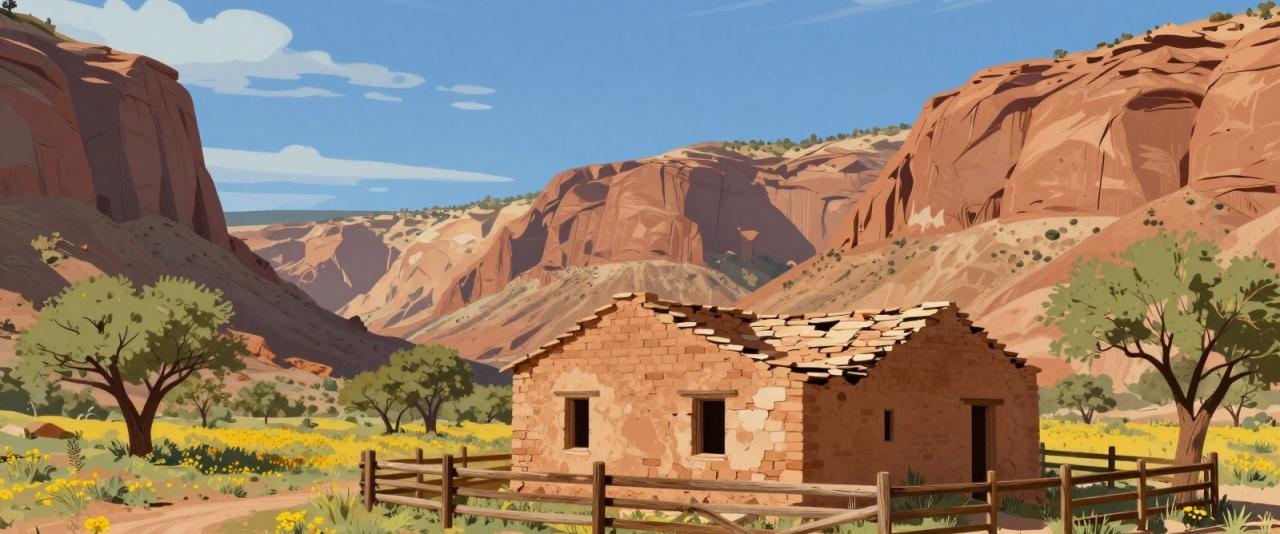
Dust here has a habit of waiting. It suspends in the air like a held breath, suspended in the golden light of the high desert. Grafton is not a ruin in the traditional, crumbling sense; it is a time capsule, preserved in the dry air. The 1886 adobe meetinghouse, which doubled as the school, stands against the red rock beneath Zion’s cliffs; it appeared in Butch Cassidy and the Sundance Kid.
There are no ghosts here, not in the spectral sense, but the memory of them is palpable. Founded in 1859 by Mormon farmers along the Virgin River, the town was worn down by floods and was empty by the 1940s, leaving behind only the echo of its former life. You walk the path, and the only sound is the wind, rustling through the dry grass. It is a reminder of how quickly nature reclaims what is left behind. The air is cool, even in the summer heat, offering a sharp contrast to the sun-baked rock. This is not a place to be rushed. It is a place to be, to stand, to feel the weight of history in the silence.
Capturing the Light
The desert light is deceptive. It is bright, harsh, and unforgiving, but it is also fleeting. In the high desert, the sun does not just set; it retreats, pulling the light away with a speed that can catch the unprepared off guard. Golden hour here is not a gentle fade; it is a sudden shift, a dramatic change in the quality of light that transforms the landscape in minutes.
You must act quickly. The old walls of the historic structures glow with a golden hue, but only for a moment. The shadows lengthen, stretching across the sand, defining the edges of the rocks and ruins. There is no time to waste, no time to adjust settings slowly. The best light is already moving, slipping away as quickly as it arrived. You must be ready, camera in hand, to capture the moment before it is gone. The desert does not wait. It does not pause. It simply is, and it moves on.
The Road Ahead
The engine cuts. The silence crashes in.
You step out. The gravel crunches under your boots, a sharp, grounding sound. Old walls rise up before you, stark against the red rock, standing as silent sentinels in the heat. The heat is real, the heat is here, and it is heavy. But within that heat, there is a quietude that is rare and precious.
This is not a place for the hurried. It is a place for the present. Do not just look. Feel the dust. Touch the stone. Listen to the wind. The road ahead is not just a path; it is a journey into the heart of the landscape, into the heart of the story. And the story is waiting for you.