Arches and Canyonlands both stay open 24 hours a day all winter, and you do not need a timed-entry reservation for Arches: the park dropped the requirement for 2026. December to February are the quietest months around Moab. The National Park Service's averages for Arches are a high of 44-52 °F and a low of 22-28 °F, with frost on 22 to 28 nights a month. Fewer services run, though. Canyonlands' Needles visitor center closes from early December to February 13, 2027, on November 3 the White Rim Road was blocked to 4WD vehicles at Murphy Hogback, and some Moab restaurants close for weeks in January and February.
Quick facts (checked November 6, 2026)
- Arches timed entry: not required in 2026. The park has said nothing yet about 2027. The Fiery Furnace still needs a permit, but Devils Garden Campground is first-come, first-served from November to February.
- Entry: $30 per vehicle, $25 per motorcycle, $15 per person on foot or bike, valid 7 days, at each park. Card only. Arches and Canyonlands do not charge the $100 non-resident fee.
- Visitor centers: Arches 8:30 a.m. to 4:30 p.m. daily through February, closing at noon on December 24 and closed December 25. Island in the Sky 9 a.m. to 4 p.m. from late November to early March. The Needles is closed from December 6 until it reopens on February 13, 2027.
- Dead Horse Point State Park: open 6 a.m. to 10 p.m. all year, $20 day pass per vehicle.
- Ice: the NPS says the Delicate Arch trail "can be icy through early spring". Bring traction devices.
- Roads: call 1-866-511-UTAH (8824) or check udottraffic.utah.gov for state highways.
Does Arches need a timed-entry reservation in winter?
No. On February 18, 2026 Arches announced that it "will not require advanced timed-entry reservations this year", and that visitors "may enter the park at any time during operating hours". You still need a pass or entrance fee, bought at the entrance station or on Recreation.gov. As of November 6, 2026 the park had published nothing about timed entry for 2027, so check the park's news page before a January or February trip.
Two things still need booking. Fiery Furnace hikes require a reservation (in winter only the self-guided permit, since ranger-led hikes run from spring to fall), and so does Devils Garden Campground in its reservable season. From November to February the campground switches to 25 first-come, first-served sites, with restrooms and drinking water. The park asks winter campers to download the Recreation.gov app before arriving and pay with its Scan & Pay option.
 Snow on a juniper in front of Balanced Rock in December. Image: Arches National Park from Moab, Utah, Public domain, via Wikimedia Commons.
Arches National Park is 5 miles north of Moab on US 191. From the entrance it is 9.2 miles to Balanced Rock, 12 miles to the Windows, 13.2 miles to the Wolfe Ranch trailhead for Delicate Arch and 18 miles to Devils Garden, about 40 to 45 minutes' drive. Entrance lines of over an hour are a March-to-October problem. Arches offers no ranger programs in winter, but its visitor center stays open daily, from 8:30 a.m. to 4:30 p.m. between November 1 and February 28, except that it closes at noon on December 24 and all day on December 25.
Snow and ice in Arches, and the Delicate Arch trail
Big snowfalls are uncommon in Moab's canyons, the park says, but "even small amounts of snow or ice can make local trails and roads impassable". After a snowfall the park road can close for several hours while it is plowed. Even when it reopens, shaded parts of roads, parking lots and pullouts can stay icy.
 Slush and melting snow at Park Avenue after a winter storm. Image: Arches National Park, Public domain, via Wikimedia Commons.
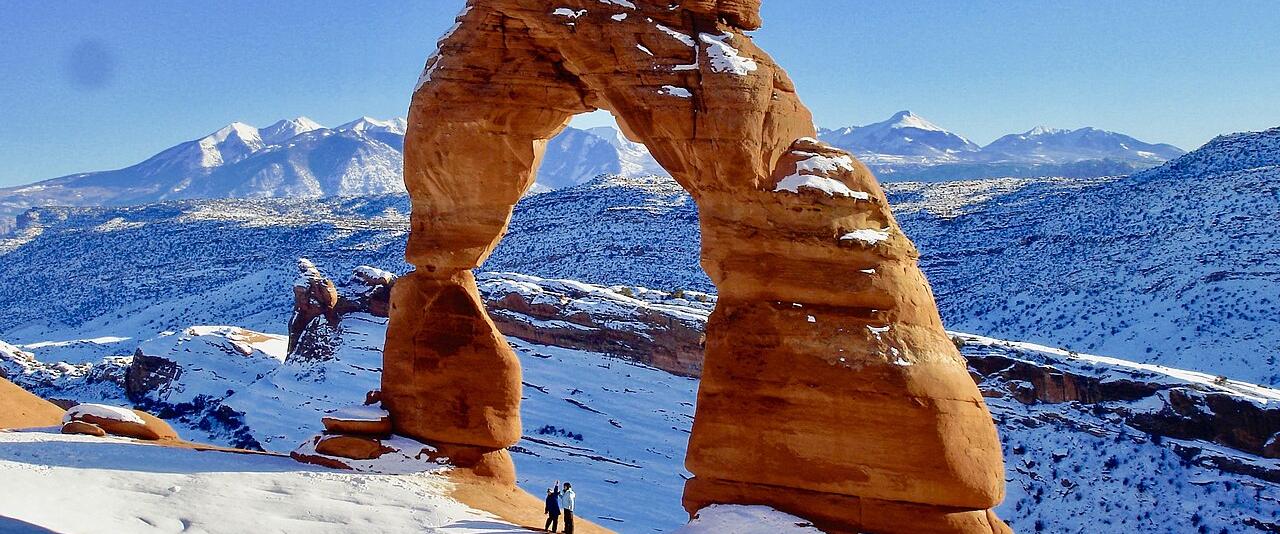
The trail to Delicate Arch is the one to plan around. It runs 3 miles round trip from Wolfe Ranch and climbs 480 feet, mostly over open slickrock, past the Wolfe Ranch cabin and a panel of Ute petroglyphs. The park's winter page warns that shady trails like this one "can be icy through early spring". After snow it and the Devils Garden trail "quickly become slippery from packed snow and ice". The park recommends traction devices and trekking poles, and notes that drifting snow can hide the trail markers. On the trail page it adds that rangers "frequently rescue people who underestimated the trail's difficulty", whether from summer heat or winter ice.
If the trail looks too icy, there are two viewpoints nearby. The Lower Delicate Arch Viewpoint is a level 100-yard walk and shows the arch from a mile away. The Upper Viewpoint is a half-mile walk with stairs and has a clearer view. The visitor center posts recent photographs of trail conditions, so look at them before you drive out.
Canyonlands: Island in the Sky and the Needles in winter
Canyonlands National Park is open all year, and its developed campgrounds at Island in the Sky and the Needles stay open on a first-come, first-served basis. The park's winter advice is that you "will need to be more self-reliant". Neither district has gas, food or lodging.
Island in the Sky is the easy district from Moab: 10 miles north on US 191, then 22 miles on Utah 313, about 40 minutes in all. Its visitor center is open from 9 a.m. to 4 p.m. daily from late November to early March. It closes at 1 p.m. on Christmas Eve and all day on Christmas Day. Water is available there only while the visitor center is open, and Willow Flat campground has none. On the trails, the park warns that "sandstone covered with snow and ice is treacherous", that snow can bury the cairns, and that ice lasts in shady spots. It recommends instep crampons or similar traction. The paved scenic drive can close for a while after snow while crews plow it.
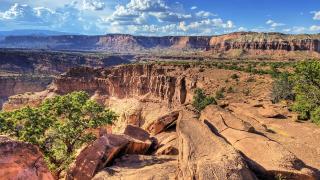
 The snow-capped La Sal Mountains seen from Canyonlands National Park in March. Image: CanyonlandsNPS, Public domain, via Wikimedia Commons.
The Needles is farther: 40 miles south of Moab on US 191, then about 35 miles west on Utah 211, the only paved road in. Its visitor center closes for the winter on December 6 and reopens on February 13, 2027. That is also the only place in the district with water, so bring all you need. Rangers stay on duty in the area, and the campground remains open.
Dead Horse Point State Park
Dead Horse Point State Park is on the same road as Island in the Sky, Utah 313, so most visitors combine the two. Utah State Parks lists it as open all year from 6 a.m. to 10 p.m.. The visitor center is open daily from 7 a.m. to 5 p.m. but closed on Thanksgiving, Christmas Day and New Year's Day (435-259-2614). A day-use pass is $20 per vehicle, for up to eight people, and is valid only on the day you buy it. It does not cover Canyonlands, which needs its own fee.
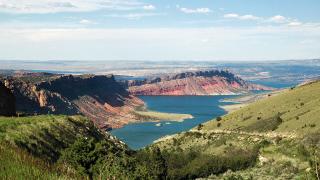
 Cliffs at the edge of Dead Horse Point above the Colorado River canyon. Image: dschwen, CC BY-SA 3.0, via Wikimedia Commons.
The park is an International Dark Sky Park, but day use ends at 10 p.m. The park asks stargazers to go elsewhere after that unless they are camping in its campgrounds or yurts, or on a ranger program. Moab's tourism office puts it simply: "Dead Horse Point in fresh snow is about as good as this landscape gets."
Shafer Trail, White Rim and Potash Road
These unpaved roads below Island in the Sky are the ones most likely to change your plans in winter. The NPS caption on its winter page reads: "Shafer Trail is often impassable during winter due to snow and ice." Its road report of November 3, 2026 listed:
- Shafer Trail: open, high-clearance 4WD recommended, with washboarding, mud and ruts above the switchbacks.
- Potash Road: open, high-clearance 4WD recommended, heavy washboarding on the east side, mud and washouts.
- White Rim Road: open, but the full loop was passable only to motorbikes and bicycles on the west side because of rockfall, and 4WD vehicles could not travel past Murphy Hogback in either direction. High-clearance 4WD with low range is required.
- Mineral Bottom: open, but travel not advised because of mud.
 The Shafer Trail switchbacks dropping from the Island in the Sky mesa. Image: KimonBerlin, CC BY-SA 2.0, via Wikimedia Commons.
The 100-mile White Rim Road needs a permit for every trip, day or overnight. Day-use permits go on sale on Recreation.gov at 8 a.m. Mountain Time the day before, with a $6 fee, or free at a visitor center on the day. When the visitor center is closed you must book online at least two days ahead, or use the Backcountry Reservation Office in Moab. The Shafer Trail and Potash Road need no permit. The park says that in winter all vehicles should carry chains, and it warns that backcountry tows cost more than $1,000. Ask at the Island in the Sky visitor center on the day, because one storm can change everything on this list.
Getting to Moab: flights to CNY and Grand Junction
Moab's own airport is Canyonlands Regional (CNY), 11 miles from the Arches entrance. The Moab Office of Tourism lists nonstop flights from Denver on United, year-round, and from Salt Lake City on Delta, seasonal. It does not give the season's dates, but travel press reported in July 2026 that the Salt Lake City flights pause after November 30 and resume on March 8, 2027, so check with Delta before you plan around them.
The larger option is Grand Junction Regional (GJT) in Colorado, 109 miles from the Arches entrance. Its airlines page, updated November 3, 2026, lists American to Dallas and Phoenix, Breeze to Las Vegas, Delta to Salt Lake City and United to Denver. Salt Lake City International is 230 miles from Arches. Amtrak's California Zephyr stops at Green River, 45 miles from the park, and at Grand Junction. Moab's tourism office notes that airport shuttles run by appointment only.
What's open in Moab in winter
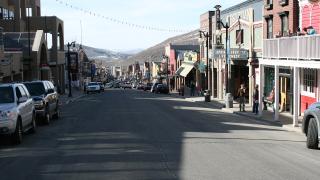
The Moab Information Center, at Main and Center Streets, is open daily from 9 a.m. to 4 p.m. It has weather and road information, maps and a 20-minute film. Moab's tourism office says many hotels offer winter deals and that "a large number of Moab's retail shops and galleries are open throughout the year". It is also frank about the other side. In winter "few restaurants are open and almost no guiding companies", and some businesses take breaks in January and February. Its own list of winter closures includes several restaurants shut for weeks between early January and mid-February. Ring ahead before you count on a particular meal or tour.
 The pedestrian bridge over the Colorado River at Moab on a cold, still day. Image: Akos Kokai, CC BY 2.0, via Wikimedia Commons.
Early December brings the town's Electric Light Parade, held on the first Saturday of the month, which this year is December 5, 2026. If you want snow rather than red rock, the La Sal Mountains near Moab have cross-country skiing, sledding and snowshoeing off the Geyser Pass Road. The road is plowed to a parking area at 9,600 feet, but 4WD or chains may be needed. Call 435-259-SNOW from November to April for mountain weather, roads and avalanche conditions.
Planning notes
- Weather: NPS averages for Arches are 45 °F by day and 23 °F at night in December, 44/22 °F in January and 52/28 °F in February. The record January low is -1 °F.
- Daylight: the US Naval Observatory gives sunrise at 7:32 a.m. and sunset at 5:01 p.m. on December 21, and 7:09 a.m. and 5:56 p.m. on February 15.
- Passes: the $55 Southeast Utah Parks annual pass (US residents) covers Arches, Canyonlands, Natural Bridges and Hovenweep. Dead Horse Point is a state park and sells its own pass.
- Before you set out: check each park's alerts, the Canyonlands road report, and udottraffic.utah.gov or 1-866-511-UTAH (8824) for state roads.
 Wind blowing snow off the rim near Moab during a December storm. Image: Arches National Park, Public domain, via Wikimedia Commons.
Hours, prices and road conditions here are as the National Park Service, Utah State Parks, the Moab Office of Tourism and Grand Junction airport published them on November 6, 2026. Canyonlands' backcountry roads in particular can change with every storm.