Zion in winter has one rule that changes everything else: from November 29 to December 25, 2026 there is no shuttle, and you can drive your own car up Zion Canyon Scenic Drive. The free shuttle comes back for the holidays, December 26 to January 2, and on those days private cars are again kept off the road. The park has not yet published its shuttle dates for 2027. In early 2026 there was no shuttle from January 4 until March 7. This guide covers what that means in practice, as of November 2026: where you can park, which trails are open or icy, how Angels Landing permits work in winter, what the river is like in the Narrows, and what it costs to get in.
Quick facts (checked November 6, 2026)
- Park hours: open 24 hours a day, every day of the year.
- Your own car on the Scenic Drive: November 29 to December 25, 2026, and again after January 2, 2027 (the park has not published its 2027 shuttle dates yet).
- Holiday shuttle: December 26 to January 2, first bus 8 a.m. from the Zion Canyon Visitor Center, last bus out of the canyon 5:45 p.m.
- Entry: $35 per private vehicle, $30 per motorcycle, $20 per person on foot or bike, valid 7 days. Non-US residents aged 16 and over also pay $100 each unless they hold an annual or America the Beautiful pass.
- Angels Landing: a permit is needed all year. In winter that means the day-before lottery ($6 to apply, $3 per person if you win).
- Visitor center: Zion Canyon Visitor Center 8 a.m. to 5 p.m. Park information line: 435-772-3256.
The shuttle and the Scenic Drive, week by week
The park published its 2026 shuttle timetable in February, and its shuttle page, updated in October, shows the same dates. Here is how it runs from late autumn into the new year:
- Until November 28: shuttles run from 7 a.m. The last bus leaves the visitor center at 5 p.m., and the last one leaves the Temple of Sinawava, at the end of the canyon, at 6:15 p.m. Private cars are not allowed on the Scenic Drive.
- November 29 to December 25: no shuttle in the canyon or in Springdale. You drive yourself.
- December 26 to January 2: holiday service. The first bus leaves at 8 a.m., the last bus up the canyon leaves the visitor center at 4:30 p.m., and the last bus back down leaves the Temple of Sinawava at 5:45 p.m. The Springdale line runs from 8 a.m. to 6 p.m. Cars are off the Scenic Drive again.
- From January 3, 2027: the park has not published dates yet. In 2026 the shuttle restarted on March 7 and there was no service from January 4 to March 6, so expect to drive.
Riding the bus takes about 45 minutes from the visitor center to the Temple of Sinawava, and buses come every 5 to 10 minutes. The park warns that if you miss the last bus you may have to walk back, which can be eight miles or more. With sunset early in December, the 5:45 p.m. last bus matters more than in summer.
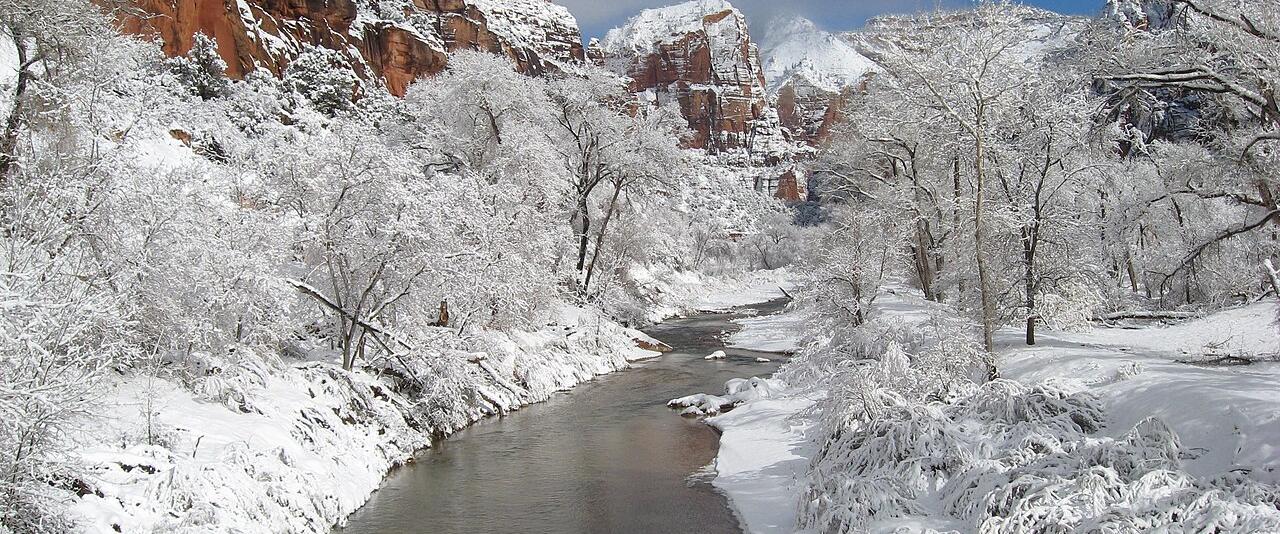
 Cottonwoods in fresh snow in Zion Canyon, with the canyon walls behind. Image: ZionNPS, Public domain, via Wikimedia Commons.
Driving the Zion Canyon Scenic Drive yourself is the big winter advantage. You can stop at Zion Lodge, The Grotto and the Temple of Sinawava when you like (the Zion Human History Museum closes for the winter at the end of November), and carry gear without hauling it onto a bus. But the parking lots in the canyon are small. The park says "parking fills early year-round", and it warns that it may close the Scenic Drive for a while when the canyon lots are full. On busy weekends, arrive early or plan a backup walk near the visitor center.
The shuttle off-season is also the only time of year that large RVs can drive up the canyon. New size limits took effect on June 7, 2026 for the Zion-Mt. Carmel Highway between Canyon Junction and the East Entrance. Vehicles longer than 35 feet 9 inches, wider than 7 feet 10 inches, taller than 11 feet 4 inches or heavier than 50,000 pounds can no longer use it. Those vehicles can still come in from the south and drive the Scenic Drive "during the shuttle off-season".
Entrance fees and the 2026 nonresident fee
Zion's entrance fees are unchanged: $35 for a private vehicle and everyone in it, $30 for a motorcycle and $20 for each person on foot or bike. All are valid for 7 days, and children 15 and under get in free. The park prefers cards, but entrance stations also take cash.
The change for 2026 is the nonresident fee. Zion is one of 11 national parks that charge every non-US resident aged 16 and over $100 per person on top of the entrance fee. You don't pay it if you enter on an annual pass or an America the Beautiful pass. The non-resident America the Beautiful annual pass costs $250, so a family or group of foreign visitors planning several parks should compare the two.
From 2026, the National Park Service's fee-free days are for US citizens and residents only. None of them falls in December 2026, and the 2027 list has not been published.
Angels Landing in winter: permits and ice
Angels Landing needs a permit all year. The park says: "No matter when you plan to hike Angels Landing, you will need a permit." The seasonal lottery for hikes from December 1, 2026 to February 28, 2027 has already closed. It took applications from October 1 to 20 and issued permits on October 25.
That leaves the day-before lottery. Apply on recreation.gov between 12:01 a.m. and 3 p.m. Mountain Time on the day before your hike, and results are sent after 4 p.m. It costs $6 to apply, and that is not refunded. If you win, you pay a further $3 per person.
 Angels Landing above the Virgin River, with snow along the banks. Image: William Herr, Public domain, via Wikimedia Commons.
Winter brings ice to the trail. The park asks hikers not to start the chained section if "the ground is wet or icy", and notes that most chain accidents happen in wet conditions. It also warns that the metal chains get very cold, so wear gloves. On Presidents Day weekend 2026 it added: "Be prepared for ice on the trail, particularly in areas that do not receive sunlight." You don't need a permit to hike the West Rim Trail from The Grotto to Scout Lookout, which is a good turnaround point when the fin is icy.
The Narrows and the Riverside Walk
The Narrows is open in winter unless the river is too high. The park closes it to all travel when the Virgin River flows above 150 cubic feet per second, or when a flash flood warning is issued, and it says that "winter and early spring commonly bring high water levels and cold water." Check the flow on the park's conditions page on the morning of your hike.
The cold is the main hazard. The canyon gets little sun, and the park says the water "can drop close to freezing". It recommends waterproof gear such as drysuits or waders, and quick-drying clothes to prevent hypothermia. You don't need a permit to walk upstream from the Temple of Sinawava as far as Big Spring. The 16-mile top-down route from Chamberlain's Ranch needs a wilderness permit.
 Snow on the canyon rim above the Riverside Walk. Image: Zion National Park, CC BY 2.0, via Wikimedia Commons.
To get to the river you walk the paved Riverside Walk, 1 mile from the Temple of Sinawava. It is open all year, but the park says sections may close in winter "due to icy and unsafe conditions". Even if you don't plan to get wet, the Riverside Walk is one of the easiest snow walks in the canyon.
Other trails: what's open, what's icy, what's closed
Ice is the common thread. The Watchman Trail, a 3.3-mile round trip from the visitor center, "may be muddy or icy during the winter." Shaded sections of every trail can stay icy for days after a storm, so pack traction devices.
These were the closures on the park's conditions page as of November 2026:
- Hidden Canyon is closed.
- Observation Point cannot be reached from Zion Canyon.
- The East Rim Trail is partly closed after a large rockfall.
Weeping Rock is open again. The park reopened the trail and Shuttle Stop 7 on September 5, 2025, after a closure that began with a November 2023 rockfall. It is a short, steep 0.4-mile walk with 98 feet of climbing.
The Emerald Pools Trail, across the road from Zion Lodge, is easy to reach when you can drive to the lodge stop.
 Lower Emerald Pool in January. Image: Zion National Park, Public domain, via Wikimedia Commons.
For a flat, safe option, the Pa'rus Trail is paved and runs 3.5 miles from the visitor center to Canyon Junction. It is the only trail in Zion where leashed pets are allowed, and bikes can use it too. On the east side, beyond the tunnel, the 1-mile round-trip Canyon Overlook Trail is open all year, but its parking is very limited.
The east side road had a rough autumn. A large rock formation fell onto the Zion-Mt. Carmel Highway on September 30, 2026, and the park reopened it to visitors on October 9. The repaired section has a temporary gravel surface until it is repaved, and the park says the highway is sometimes closed for snow, ice or rockfall.
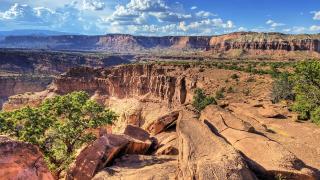
 Checkerboard Mesa on the Zion-Mt. Carmel Highway in late December. Image: Ken Lund from Reno, Nevada, USA, CC BY-SA 2.0, via Wikimedia Commons.
Kolob Canyons in winter
Kolob Canyons is the park's northwest corner, reached from Exit 40 on Interstate 15 rather than through Springdale. A five-mile scenic drive starts at the Kolob Canyons Visitor Center and runs past the red finger canyons, and the park lists the Timber Creek Overlook Trail among the walks there. You pay the same entrance fee here, and the same nonresident fee applies.
Winter is the catch. The park says the Kolob Canyons Road "may be closed during winter months due to snow or ice", and on its conditions page it says the road "closes frequently in winter". Call 435-772-3256 or ask at a visitor center before you make the detour. The Kolob Canyons Visitor Center is open 8 a.m. to noon and 1 to 5 p.m. Its wilderness desk is closed until further notice. The Kolob Terrace Road, a separate road, is usually closed for several months from fall to spring.
 Kolob Canyons Road after snow, with the finger canyons ahead. Image: Zion National Park, Public domain, via Wikimedia Commons.
Springdale and park services in winter
Springdale sits right outside the South Entrance, and in winter you will probably park there at least once. The town runs paid parking from 6 a.m. to 5 p.m. daily:
- Zone A (park entrance to Shuttle Stop #4): $25 all day, $20 after 1 p.m.
- Zone B (Sundance Road to Anasazi Way): $20 all day, $15 after 1 p.m.
- Zone C (Lion Boulevard): $15 all day, $10 after 1 p.m.; also the only zone for vehicles over 24 feet, at $30 a day.
You can pay for up to three days in a row, but you can't sleep in your vehicle in a paid area. From November 29 to December 25 there is no Springdale shuttle, so you will walk from your parking spot to the pedestrian entrance or drive in. The town line runs again from December 26 to January 2.
Inside the park, the Zion Canyon Visitor Center and its wilderness desk are open from 8 a.m. to 5 p.m. The Human History Museum is open only from spring to fall and closes for the winter at the end of November, after Thanksgiving. Zion Lodge stays open all year with fewer services in winter. Watchman Campground is open all year and takes reservations on recreation.gov. South Campground, which reopened in 2026, and Lava Point close for the winter.
Weather and planning tips
At the park's own weather station, the 1991-2020 averages are:
- December: 52.5 °F by day, 29.3 °F at night.
- January: 53.8 °F by day, 30.4 °F at night.
- February: 57.6 °F by day, 33.6 °F at night.
Average monthly snowfall in the canyon is light: 1.7 inches in December and less than an inch in January and February.
- Go midweek if you can. On holiday weekends in winter the park still expects long lines at entrance stations, parking lots and restrooms.
- Plan around daylight. Short days and the early last bus over the holidays leave less time for long hikes.
- Have a plan B. If the canyon lots are full, the Pa'rus and Watchman trails start at the visitor center.
For the seasons compared side by side, see our best time to visit Zion. For the park as a whole, start with the Zion National Park page.